
Moving to Alpharetta, Georgia: Is It the Right Fit for You and Your Family?
Alpharetta, Georgia is one of Metro Atlanta’s most desirable North Fulton communities for people who want a suburban lifestyle with strong schools, polished amenities, job access, shopping, dining, parks, and a more upscale community feel. Located about 25 miles north of downtown Atlanta, Alpharetta sits in the heart of North Fulton near Roswell, Milton, Johns Creek, and Sandy Springs. It offers access to GA-400, regional employment centers, Hartsfield-Jackson Atlanta International Airport, and the broader Metro Atlanta economy.
For families and professionals moving from outside Georgia, Alpharetta often stands out because it offers a balance of convenience, community, education, housing options, and lifestyle. It feels suburban, but not sleepy. It has walkable mixed-use areas, major shopping and dining destinations, parks, trails, concerts, business hubs, and community events. The city describes itself as “Georgia’s Connected City,” and that positioning fits: Alpharetta connects residents to work, schools, entertainment, outdoor spaces, and the broader Atlanta region.


What is Alpharetta known for?
Alpharetta is known for its strong quality of life, polished suburban environment, highly regarded schools, growing technology and business presence, and destination areas like Downtown Alpharetta, Avalon, North Point, Ameris Bank Amphitheatre, Wills Park, and the Alpha Loop. The city blends small-town warmth with metro-level amenities, which is one of the reasons it continues to attract families, executives, entrepreneurs, and relocation buyers.
Alpharetta is not the cheapest place to live in Metro Atlanta, and that matters. The appeal comes with a higher housing price point than many other Georgia suburbs. But for buyers who prioritize schools, lifestyle, location, safety, shopping, dining, and access to professional opportunities, Alpharetta is often worth serious consideration.
Where is Alpharetta?
Alpharetta is located in North Fulton County, roughly 25 miles north of downtown Atlanta. It is part of the North Fulton area, which also includes nearby communities such as Roswell, Milton, Johns Creek, and Sandy Springs. This location matters because Alpharetta gives residents access to Metro Atlanta while still offering a more suburban environment.
For relocation buyers, the key question is not only “How far is Alpharetta from Atlanta?” The better question is: Where will you work, where will your children go to school, and how often will you need to drive during peak traffic?
Alpharetta offers access to GA-400 and MARTA bus routes, including connections to the North Springs MARTA rail station, but it is still primarily a car-oriented city. Buyers relocating from places like New York, Chicago, Washington, D.C., or Boston should expect a much more driving-based lifestyle.
Alpharetta Lifestyle
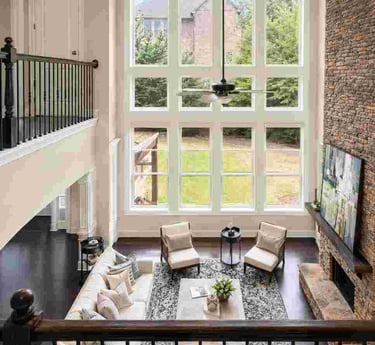
Alpharetta is best described as upscale suburban living with modern convenience. It is a place where you can find established neighborhoods, newer townhomes, luxury homes, apartments, walkable shopping districts, parks, schools, restaurants, and major employers all within a relatively compact area.
The city has more than 300 food and beverage establishments, plus entertainment options such as Topgolf, Ameris Bank Amphitheatre, Helium Comedy Club, Avalon, and North Point Mall. It also hosts more than 150 events annually, including farmers markets, music festivals, and community gatherings.
This is one of Alpharetta’s biggest advantages: you do not have to drive into Atlanta every time you want something to do. Alpharetta has enough restaurants, entertainment, parks, shopping, and events to feel self-contained.
Housing in Alpharetta
Parks, Trails, Outdoors
Jobs and Business Access
Commute & Transport
Shop, Dine, Entertain
Education Beyond K-12
Alpharetta offers a mix of single-family homes, townhomes, condos, apartments, rentals, luxury properties, and walkable mixed-use housing near shopping, dining, parks, and amenities. For out-of-state buyers, Alpharetta may feel more affordable than some high-cost markets, but it is best suited for buyers prioritizing lifestyle, location, schools, and long-term desirability over getting the most square footage for the lowest price.
Alpharetta has made outdoor access a major part of its planning, with more than 30 parks, Wills Park’s equestrian center, and a goal for 77% of residents to live within a 10-minute walk of a park by 2029. The Alpha Loop is a key lifestyle feature, connecting neighborhoods to Avalon, Downtown Alpharetta, shops, restaurants, parks, and entertainment. Alpharetta offers more than subdivisions; it is designed around parks, walkable destinations, and community gathering spaces.
Offers convenient access to GA-400, major interchanges, MARTA bus service to the North Springs rail station, and is about 34 miles from Hartsfield-Jackson Atlanta International Airport. For relocation buyers working in North Fulton, Alpharetta can be very practical, but commuting to downtown Atlanta during peak traffic should be tested before buying. In Metro Atlanta, mileage does not tell the full story because time of day, direction, school traffic, weather, and GA-400 access can make a major difference.
Offers higher education and workforce development through Georgia State University and Gwinnett Technical College campuses, with Georgia Tech, Emory, and Kennesaw State within about an hour’s drive. The city is primarily served by Fulton County Schools, with strong graduation rates, ACT performance, AP participation, and options like Fulton Science Academy and FCS Innovation Academy. Verify school assignments directly with Fulton County because zoning depends on the exact property address and can change.
Alpharetta is one of North Atlanta’s strongest lifestyle cities, with destination areas like Avalon, Downtown Alpharetta, North Point, and surrounding retail and restaurant districts. The city offers more than 300 food and beverage establishments, ranging from fine dining and international cuisine to Southern comfort food. For out-of-state buyers, Alpharetta stands out because it offers suburban comfort without feeling limited, quiet, or overly chain-driven.
A major North Fulton employment and business hub, with more than 20 million square feet of office space and more than 14 million square feet of retail space. Alpharetta is not just a bedroom community for Atlanta; many people live and work nearby in technology, professional services, healthcare, and corporate operations. For households working in North Fulton, Alpharetta can offer a more practical daily rhythm than commuting from farther south.


What Types of Buyers May Like Alpharetta?
Approximately 60% of residents are homeowners. Alpharetta may be a good fit for:
Families looking for strong schools and community amenities. A 94.4% high school graduation rate.
Professionals who work in North Fulton, Sandy Springs, Buckhead, Midtown, or remotely.
Buyers who want suburban living without giving up dining, shopping, and entertainment.
Relocation buyers who want a polished, established, well-known Metro Atlanta suburb.
People who want access to parks, trails, concerts, restaurants, and community events.
Buyers who like mixed-use districts such as Avalon and Downtown Alpharetta.
It may not be the best fit for buyers who want the lowest home prices, a rural feel, heavy acreage, a fully urban environment, or a lifestyle centered around public transportation.

67,200+
41.3
MEDIAN AGE (YEARS)
CITY POPULATION
$628,317
$147,612
MEDIAN HOME VALUE
MEDIAN HHI
Pros and Cons of Living in Alpharetta


Alpharetta can be expensive compared with many other Metro Atlanta suburbs. Traffic can be a challenge, especially around GA-400 and major retail areas. Public transportation exists, but the city is still heavily car-dependent. Walkability depends on where you live; being near Avalon, Downtown Alpharetta, or the Alpha Loop is very different from being in a more traditional subdivision.
Alpharetta offers strong schools, high-quality amenities, parks, shopping, dining, and entertainment. It has a strong business base, access to GA-400, and proximity to other desirable North Fulton communities. It also offers a range of housing options, from apartments and townhomes to established single-family neighborhoods and luxury homes.
Pros
Cons
How Alpharetta compares to nearby cities


Roswell
May appeal more to buyers who want historic charm, older neighborhoods, and river access.


Milton
May appeal more to buyers who want larger lots, luxury homes, equestrian properties, and a quieter feel.


Johns Creek
May appeal more to buyers who prioritize schools, subdivisions, and family-centered living.


Sandy Springs
May appeal more to buyers who want closer access to Buckhead, Atlanta, hospitals, and corporate centers.
Alpharetta usually feels more polished, business-oriented, and amenity-rich.
Thinking about moving to Alpharetta
The best way to know if it is right for you is to compare neighborhoods, commute routes, school zones, housing options, and nearby cities before you choose. As a Metro Atlanta REALTOR®, I help relocation buyers like you understand Alpharetta and the surrounding North Atlanta communities so you can make a confident decision before you move.
Sonji Stewart, REALTOR®
Providing strategic real estate advisory across Metro Atlanta - specializes in local expertise for Alpharetta, Milton, Sandy Springs, Johns Creek, and Roswell.
DIRECTORY
Home
For Buyers
For Sellers
Relocation
Home Valuation
About
© 2026 Sonji Stewart, REALTOR® in Georgia with 20 West Realty. Equal Housing Opportunity Broker
CLARITY • CONFIDENCE • STRATEGY




We are pledged to the letter and spirit of the State of Georgia and federal policies for the achievement of equal housing opportunity. We encourage and support an affirmative advertising and marketing program in which there are no barriers to obtaining housing because of race, color, religion, sex, handicap/disability, familial status, or national origin.